
Bird joy
An overview of my watercolors of cultivated birds that are kept in bird farming.
dated 1999 until 2025
(click on an image to enlarge an artwork)
stuur een bericht

The Appelfinch (Coccothraustes coccothraustes)
2025The Appelfinch (Coccothraustes coccothraustes) is a songbird in the family Fringillidae.

Robin (Erithacus rubecula)
2025Robins, curious and trusting. Enjoy their beautiful song.

Goldfinch (Carduelis carduelis)
2023This is a songbird from the finches family. The goldfinch's distribution area covers much of Europe, North Africa, and even Asia. Yet we also see them in Australia, New Zealand and various places in America and Africa. In short, almost all over the world. Pretty right? This slender bird with a characteristic head drawing, framed with a wide white band and the back of the head black. A broad yellow band runs lengthwise in the black wings. Furthermore, it is light brown on the back and flanks, white on the underside and black on the tail. In our region, the goldfinch has long been kept as a cage bird and bred with great success. People with patience have even managed to teach the goldfinch to draw their own water from a water reservoir with a small bucket. The putter owes its Dutch name to this. A beautiful bird.

Brambling, Fringilla montifringilla - (Fringillidae)
2023Kepen come from the north and are a counterpart of 'our regular' finch. In the Netherlands they only breed with a few couples. They fare better in the Scandinavian countries where the keep is one of the most numerous breeding birds. In winter, however, you often see them in large numbers in the Netherlands. Together with the 'ordinary' finches you often see the notches in mixed groups. You generally see them in the woods with a lot of beech (for the tasty beechnuts).

Bohemian Waxwing - Bombycilla garrulus (Bombycillidae)
2023The waxwing is a beautiful thrush-like bird with a salmon-pink color and yellow stripes on the wings. The head bears a large crest and a black mask and throat. The anal region is reddish brown with a yellow terminal band on the tail. Despite this striking appearance, it is often overlooked because it prefers to stay high in the trees. The waxwing is about 17 cm long. It used to be thought that this bird brought the plague because it often visited the country with large groups coincidentally at those times when there was a plague. So a misconception.

Two young Splendid parakeets (Blue white belly)
2020
The Splendids inhabit a large area of Australia where they dwell in Acacia shrubs, eucalyptus trees and shrubs along the stony ridges.Engels
The distribution area is so large that they are difficult to find.
They usually live in pairs, but sometimes larger groups are also observed.
Due to the green back cover, they are hardly noticeable when looking for food on the ground, but the colored men (colourfull) do stand out when they are eating in the spinifex (grasses). Because the Splendid lives in fairly dry areas, it is said that they already get enough moisture from the dew or absorbing moist plants.
These two rascals are youngsters of this year and a mutation which is called Blue and sometimes nicknamed 'white belly'.

The Gloster (Consort & Corona) canary
2020The Gloster is one of the smaller types of posture canaries and best known for its healthy and distinct appearance. It also grows quite easily. The Gloster Fancy, also known as the Gloster canary, can be divided into two groups: the Gloster Consort and Gloster Corona. This stands for Gladkop and Kuif. If bred well, according to the standard of the N.B.v.V., then it is a grateful exhibition bird.

The Red Mosaic canary
2020The Red mosaic is a so-called fat canary (without dashes) that has left both the red color and the drawing with the crossing of the cape siskin in the canary. After selection, a beautiful drawing came out and it was possible to hold on to it. A nice contrasting bird.

The Black with yellow canary (classic color canary)
2020The standard requirements of this classic canary are, among other things, that the oxidation of the BLACK must manifest itself to the maximum in the feathering. The back and flanks show well-marked black stripes that contrast with a highly oxidized surface without visible phaeomelanin. The melanin must start from the beak base. The legs, nails and beak are black. Yes, you can find a lot of them, but if the breeder is enthusiastic you will get very beautiful birds.
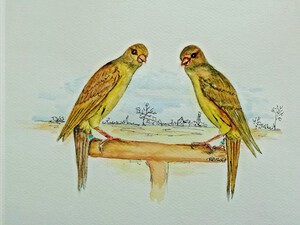
De Japan Hoso canary
2020The Japan Hoso is a fairly young posture canary breed. Only in 1977 was this breed adopted by the C.O.M. (Confédération Ornithologique Mondial) recognized and included in the (so-called) standard. The Japan Hoso is a smaller edition of the Glasgow Don (the oldest form of the Scotch Fancy) and therefore has the striking feature of the crescent or circular body. In Japan, the Japan Hoso is exhibited in handmade cages made of wood and bamboo. In Europe, the “Japan Hoso” can be found since the late 1950s, early 1960s.
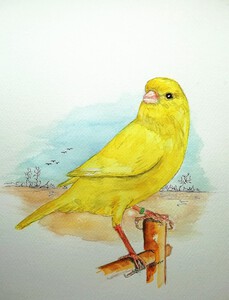
'Just' a yellow (intensive) canary!
2020This is NOT the wild color (although it is often thought so) but a color (mutation) stroke in the demand program of the Dutch Birdwatching Association and has undergone a major development in the last 15 to 20 years. A sought-after bird among many color canary breeders. They are often beautiful show birds, not only perfect yellow but also very beautiful in model. Not comparable with the many other colors in our canaries. Compared to the color white, there are many more options with the color yellow. Not only in the intensive and mold, but also in the mosaic. Also in ivory and with or without red eyes. Less well known in the Netherlands, even yellow birds with white wings. So there are many challenges.
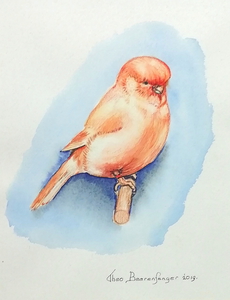
The Norwich canary
2019The impressive Norwich canary; Originating in Norwich (England), this giant is the big brother of the Gloster consort canary.
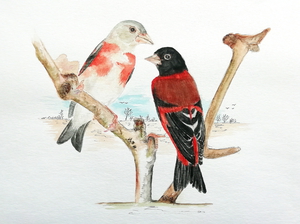
Red siskin, Carduelis cucullata
2019The Red siskin (Carduelis cucullata) is an endangered bird species from northern South America. The bird is widely bred but is a protected bird.
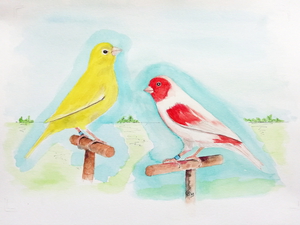
Color canaries, Lipochrome
2019Color canaries, Lipochrome. 'Vetstof' was the old name but I find it easier to call it the red mosaic and a yellow canary. There are hundreds of types of canaries. These are two types.
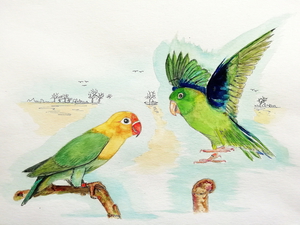
Curved beaks
2019Two curved beaks, on the left a lovebird and on the right a Forpus. There are also many types of curved beaks with the most beautiful colors.
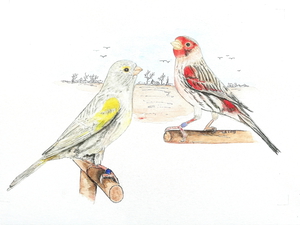
Mosaic canaries
2019Two mosaic canaries. The Agate red mosaic (right) and the Agate yellow opal mosaic (left.). There are hundreds of colors and types of canaries, did you know that?

Neophema Splendida
2019A mutation of the Neophema Spledid parakeet. Color is Turquois cinnamon. It is a male. Is regularly bred in bird farming. A nice mutation.
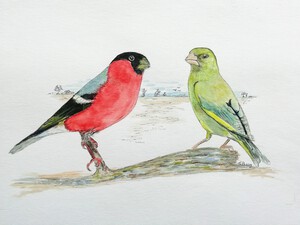
Wild birds, Bullfinch, Greenfinch
2019Two icons in wild bird breeding. The Bullfinch and the Greenfinch. Two toppers.
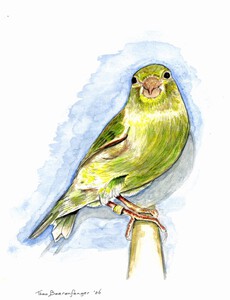
Spanish Timbrado
2006The Spanish Timbrado is in the Netherlands, and Spain as mother country, a much loved singing canary with a spicy temperament.

Long-tailed duck on the nest.
1999Created this watercolor on the occasion of our new home (Type Long-tailed Duck). A bird expert said it was a male but I doubt it because usually the females take care of the brooding.